Your Newsletter Has a Growth Ceiling. Here's the Formula.
Your list has a maximum size you can calculate today: monthly new subscribers divided by monthly churn rate. At 500 signups a month and 2% churn, you will approach 25,000 and stop — no matter how long you keep publishing. The math behind the plateau, why halving churn beats doubling acquisition, and the one term that removes the ceiling entirely.
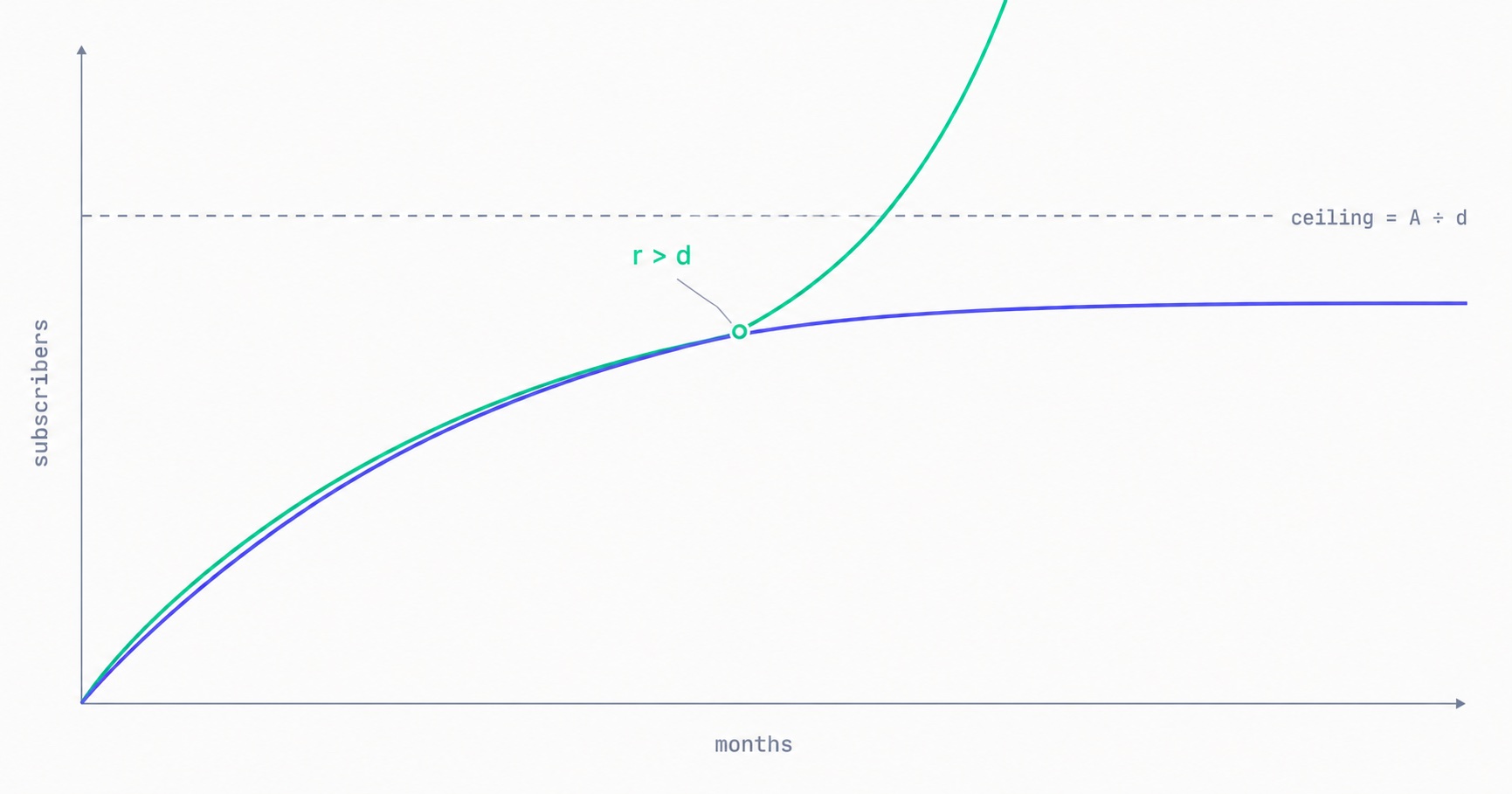
Your newsletter has a maximum size, and you can calculate it right now with two numbers you already have.
Ceiling = monthly new subscribers ÷ monthly churn rate.
Adding 500 subscribers a month with 2% monthly churn? Your list will approach 25,000 and stop. Not slow down temporarily. Stop. You can publish at that pace for another decade and land in the same place, because the arithmetic that produced the plateau does not care how long you keep going.
This is not a motivation problem or a content problem, and it is the single most common reason creators describe growth as "stalling for no reason." The formula is well established in subscription businesses. Almost nobody applies it to newsletters, which is why the plateau keeps surprising people who are doing everything right.
Where the formula comes from
A list changes size according to two forces working against each other.
Arrivals are roughly constant. Whatever acquisition you are doing — content, referrals, cross-promotion, social — produces some number of new subscribers per month. Call it A. It fluctuates, but it does not scale with how big your list already is.
Departures are proportional to list size. Unsubscribes, hard bounces, and subscribers going quiet all scale with how many people are on the list. A 5,000-person list losing 2% monthly loses 100 people. A 40,000-person list at the same rate loses 800.
That asymmetry is the whole story. Your inflow is flat. Your outflow grows as you grow.
Net monthly change is therefore A − (d × L), where d is your monthly churn rate and L is current list size. Growth stops when those balance. Set the change to zero, solve for L, and you get:
L* = A ÷ d
At 500 new subscribers a month and 2% churn: 500 ÷ 0.02 = 25,000.
Why the plateau ambushes people
The approach to the ceiling is deceptive, and that is what makes it feel like something broke.
Take that same creator — 500 new subscribers monthly, 2% churn — and watch what they experience at different list sizes.
- At 3,000 subscribers: losing 60, gaining 500. Net +440 a month. Growth feels effortless.
- At 10,000: losing 200, net +300. Still healthy.
- At 18,000: losing 360, net +140. Noticeably slower.
- At 23,000: losing 460, net +40. Feels broken.
- At 25,000: losing 500, net zero.
Nothing changed. The creator did not get worse at writing, the algorithm did not turn on them, and their acquisition did not dry up — they are still adding exactly 500 people a month, the same as when growth felt easy. The arithmetic simply caught up.
This is the point where most creators start working harder on the wrong lever, which brings us to the part that actually reorders priorities.
Doubling acquisition and halving churn do exactly the same thing
Look at the formula again. Both variables move the ceiling with identical force.
- Double acquisition, 500 → 1,000 a month: ceiling goes from 25,000 to 50,000.
- Halve churn, 2% → 1% a month: ceiling goes from 25,000 to 50,000.
Same result. Now consider what each one costs you.
Doubling sustained acquisition means permanently doubling your growth output — twice the content, twice the cross-promotions, twice the referral volume, forever. Not one good month. A new permanent baseline.
Halving churn means fixing things that are largely one-time structural work: a lead magnet specific enough that the wrong people stop subscribing, a welcome sequence that establishes a reading habit in the first week, a consistent publishing cadence, and a sunset policy that stops dead weight from accumulating.
Most creators spend nearly all their effort on the harder lever, because acquisition is visible and churn is not. Your dashboard shows new subscribers in a big number at the top. It rarely shows you what percentage of last year's cohort is still opening.
The term that removes the ceiling entirely
Everything above assumes acquisition is independent of list size. There is one form of acquisition where that is not true, and it changes the equation qualitatively rather than just moving the number.
Referrals scale with your list. If some fraction of subscribers brings in a new subscriber each month, acquisition has a component proportional to L.
Let r be the fraction of your list that refers someone monthly. Now:
Net change = A₀ + (r × L) − (d × L) = A₀ + (r − d) × L
The entire behaviour of your list now depends on the sign of r − d.
If r < d, you still have a ceiling, but a higher one: A₀ ÷ (d − r). With 500 baseline acquisition, 2% churn, and 0.5% referral rate, the ceiling rises from 25,000 to 500 ÷ 0.015 = 33,333.
If r > d, there is no ceiling. The list compounds instead of converging, because each new subscriber contributes to acquiring the next one faster than churn removes them. The curve bends upward rather than flattening.
That inequality — referral rate above churn rate — is the actual dividing line between a newsletter that plateaus and one that compounds. Not effort. Not consistency. Not luck. A comparison between two numbers you can measure this month.
At 2% monthly churn you need more than 2% of your list referring someone each month. On a 10,000-person list that is 200 referrals monthly. Demanding, and not fantastical — and it is exactly why referral programs and genuinely forwardable content matter far more than their reputation as a nice-to-have suggests.
Two creators, identical effort, 9× different ceilings
The formula becomes hard to ignore when you compare two creators putting in the same acquisition work.
Creator A runs a broad lead magnet, publishes when inspiration strikes, and has never run a sunset policy. They add 400 subscribers a month, churn at 3%, and get referrals from 0.2% of their list.
Ceiling: 400 ÷ (0.03 − 0.002) = 14,286 subscribers.
Creator B runs a narrow, specific lead magnet, publishes on a fixed weekly schedule, has a four-email welcome sequence, and asks for referrals inside each issue. They add the same 400 subscribers a month, churn at 1.2%, and get referrals from 0.9% of their list.
Ceiling: 400 ÷ (0.012 − 0.009) = 133,333 subscribers.
Same acquisition output. A ceiling more than nine times higher.
And Creator B is one small push from having no ceiling at all — nudging referrals from 0.9% to above 1.2% flips the sign on (r − d) and turns a bounded curve into a compounding one. That last increment is worth more than any amount of additional content output, and it is the single highest-leverage thing available to a creator in that position.
Notice what did not differ between them. Neither creator worked harder at acquisition. The entire gap comes from structural choices made once — how specific the lead magnet is, whether a welcome sequence exists, whether the schedule is predictable, whether referrals are asked for. Those are afternoon decisions with permanent effects on the ceiling.
What actually raises your churn rate
Since d is the lever most creators ignore and the one with the best return, it is worth naming what moves it.
Broad lead magnets. The largest single cause. A magnet that appeals to everyone attracts people interested in the magnet, not in your newsletter. They convert beautifully and never open again. A magnet converting at 15% with engaged subscribers builds a better list than one converting at 40% with subscribers who forget they signed up.
Inconsistent cadence. Subscribers build an open habit around a rhythm they can predict. Sending three times one week and nothing for a month breaks the habit before it forms — and a habit that never formed is a subscriber who quietly goes dormant. A content calendar is a churn tool as much as a planning tool.
Frequency mismatch. If people subscribed for weekly and you move to daily, some portion leaves regardless of quality. Changing frequency is a renegotiation of the deal they agreed to, and it is worth announcing rather than drifting into.
Content drift. Subscribers signed up for a specific subject. Gradual expansion into adjacent topics loses the people who came for the original one, usually without any explicit complaint. They just stop opening.
Deliverability decay. If your sends start landing in the promotions tab, engagement falls, which further degrades sender reputation, which pushes more mail to promotions. This is a compounding loop and it reads exactly like a content problem from the inside. Diagnosing it is covered in the deliverability guide, and you can sanity-check your engagement against category norms with the open rate benchmark checker.
Sending everything to everyone. As a list grows, subscriber interests diverge. A single undifferentiated send is increasingly irrelevant to an increasing share of your list. Segmentation is a churn reduction lever long before it is a monetization lever.
Measuring your three numbers
Almost no creator tracks all three. Here is how to get each one.
Acquisition (A₀), excluding referrals
Total new subscribers in a month, minus any you can attribute to referral. Keep the two separate — collapsing them hides the variable that determines whether you have a ceiling at all. If you are not tagging subscribers by source on signup, start now; you cannot retroactively tag people you have already collected. Source tagging is covered in newsletter analytics.
Churn rate (d)
Unsubscribes, plus hard bounces, plus subscribers crossing into dormancy, divided by list size at the start of the month.
The dormancy definition matters more than people expect. Define it on clicks, not opens. An open-based dormancy rule will never fire for the large share of your list reading in Apple Mail, because those opens register automatically whether or not anyone read the message. Use clicks and you get a signal that requires an actual human. The full mechanism is covered in why Apple broke your open rate.
A workable rule: no click in 180 days counts as dormant. Include those subscribers in your churn number even though they are technically still on the list, because they contribute nothing and they drag your engagement metrics down.
Referral rate (r)
This is the number virtually nobody has, and it is the one that decides the shape of your curve.
The cheap version: add a "how did you hear about us?" field to your signup form with "a friend or colleague" as an option. Self-reported and it undercounts, but it gives you an order of magnitude inside a month.
The accurate version: a referral mechanism with tracked links, where each subscriber gets a unique share URL and signups through it are attributed. This gives you a clean r and tells you which subscribers refer, which is almost always a small, identifiable minority worth treating well.
Calculate r as referred signups in a month divided by list size at the start. 8,000 subscribers, 40 referred signups → r = 0.5%.
Run your own numbers
Take five minutes and do this properly, because the output usually reframes what you should work on next.
- Pull last month's new subscribers, split into referred and non-referred.
- Pull unsubscribes plus bounces. Add subscribers who crossed 180 days without a click.
- Divide that total by your list size at the start of the month. That is d.
- Divide referred signups by the same starting list size. That is r.
- Compute A₀ ÷ (d − r). If r exceeds d, you have no ceiling — skip to the compounding section.
- Compare that number to where you are now.
If you are at 80% or more of your calculated ceiling, your slowdown is fully explained by arithmetic and no amount of additional publishing consistency changes it. That is genuinely useful to know, because it stops you attributing a structural outcome to a personal failing.
If you are well below your ceiling and still growing slowly, the constraint is acquisition volume rather than the ceiling, and the growth tactics in building a list from zero to 10,000 apply directly.
Which lever to pull, by stage
The right move depends on where you sit relative to your own ceiling.
Below half your ceiling: attack churn
Counterintuitive, because acquisition still feels productive at this stage — and that is exactly why it is the right moment. Every point of churn you remove raises the ceiling permanently, and fixing churn early means you never build the compounding dead weight that makes it painful later.
Concretely: make your lead magnet specific enough that people who will never read your newsletter stop subscribing to it. A broad, high-converting magnet builds a list that looks good and churns badly. Lead magnet design is a churn lever disguised as an acquisition lever.
Then build a real welcome sequence. A subscriber who forms a reading habit in week one behaves completely differently at month six than one who received a single generic thank-you.
Approaching the ceiling: attack referral rate
Once you are close, referral is the only lever that changes the shape rather than the level. Everything else just moves the asymptote.
Make individual issues genuinely forwardable, which usually means one specific, self-contained, useful idea per issue rather than a roundup of links. Roundups get read. Specific arguments get sent to a colleague.
Ask directly, inside the email, at the point where the reader has just received something valuable — not in a footer nobody reads. And give referrers something they actually want, which for most creator audiences is access or recognition rather than merchandise. Cross-promotion with adjacent creators works on the same trust-transfer mechanism and is worth running in parallel.
At any stage: run the sunset policy
Removing dormant subscribers feels like moving backwards and it improves nearly every number that matters. It lowers your effective d, which raises the ceiling. It lifts your engagement rates, which improves deliverability, which lifts engagement further. And it reduces what you pay to email people who will never read.
Do it in stages: identify subscribers with no click in 180 days, send a short two or three email reactivation sequence, then suppress non-responders rather than deleting them outright. Delete after a quarter if nothing changes.
The arithmetic is usually better than expected. A 20,000-subscriber list with 5,000 dormant and 5,600 genuine human opens per send is running a 28% engagement rate. Suppress the dormant 5,000 and the same 5,600 opens now sit against 15,000 subscribers — a 37% rate, with no new subscribers and no change to your content.
Where the model is too simple
Churn is not one number. New subscribers churn much faster than long-tenured ones, so a single d averages over cohorts that behave very differently. The simple formula is directionally right and good enough for planning. It will overestimate the ceiling for lists growing very fast, where the newest, highest-churn cohort dominates.
Referral rate is lumpy. It spikes after a piece that lands and decays between them, so r is an average rather than a steady rate. The threshold logic holds over quarters, not week to week.
Acquisition often correlates with list size anyway. A bigger list produces more social sharing, more search visibility, more inbound mentions — effects that are not formal referrals but behave similarly. This means the pure ceiling is somewhat pessimistic. It is also not reliable enough to plan around.
A ceiling is not automatically a problem. A 25,000-subscriber list with genuine engagement and solid monetization is an excellent business. Plenty of creators earn more from a focused 20,000 than others do from an indifferent 100,000 — the economics of that are covered in monetizing a small newsletter. The point of the formula is that you should choose your plateau rather than arrive at it wondering what went wrong.
Frequently asked questions
What is a normal monthly churn rate for a newsletter?
Most creator newsletters land somewhere between 1% and 3% monthly once you include dormancy rather than counting only explicit unsubscribes. Below 1% is strong. Above 3% usually points at acquisition quality — subscribers arriving through broad, low-relevance offers — rather than at your content. Measure your own before benchmarking against anyone else's, since the definition of dormancy varies enormously between sources.
Should I count dormant subscribers as churn if they never unsubscribed?
Yes, for planning purposes. A subscriber who has not clicked anything in six months contributes nothing to your reach, nothing to your revenue, and actively hurts your deliverability and engagement rates. Counting them as active makes your ceiling calculation optimistic in exactly the direction that will mislead you.
Does this formula work for paid newsletters?
Yes, and it is where the formula originally comes from — subscription businesses have used it for years. Apply it separately to your free list and your paid tier, because they have very different churn rates. Paid churn is usually lower and far more consequential per subscriber. Pricing and tier structure are covered in paid membership tiers.
My list is growing fine. Why should I care about this now?
Because the cheapest time to fix churn is before it compounds. At 3,000 subscribers a 2% churn rate costs you 60 people a month and is barely visible. At 25,000 the same rate costs 500 a month and requires your entire acquisition output just to stand still. The structural fixes — lead magnet specificity, welcome sequence, cadence — are the same work at either size and take effect immediately at the smaller one.
What if my referral rate is already above my churn rate?
Then you have no ceiling and your list compounds, which is the outcome this whole article is pointing at. Protect it: the thing that breaks compounding is a churn increase, usually from a burst of low-quality acquisition that pushes d above r. Growth pushes that look good in the short term can flip you back into a bounded curve.
How often should I recalculate?
Quarterly is enough for the ceiling itself. Track churn monthly, because it moves faster and it is the number most likely to drift after a change to your acquisition mix or publishing schedule.
Does a bigger ceiling actually mean more revenue?
Not proportionally, and this is worth being clear about. Revenue tracks engaged subscribers, not total ones, so a list that hits a high ceiling by accumulating semi-interested subscribers can earn less than a smaller list with genuine attention. The two variables that raise your ceiling — lower churn and higher referral rate — both happen to select for engagement, which is why raising the ceiling the right way tends to raise revenue with it. Raising it by pouring in broad, low-intent acquisition does the opposite. What monetization actually scales with is covered in the 0 to $10k/month strategy guide.
Track the numbers that set your ceiling
InfluencersKit reports subscriber source, click-based engagement, and cohort retention — the three inputs you need to calculate and raise your growth ceiling.
Stay Updated
Get the latest insights, strategies, and tips delivered directly to your inbox. Join thousands of creators who are building their email communities with our weekly newsletter.
No spam, unsubscribe at any time. We respect your privacy.
Related Articles

A Subscriber Is Worth $1.25 a Year. Now Price Your Ads.
Two sponsored slots at a $30 CPM with a 40% open rate earn about $1.25 per subscriber per year. Against a defensible CAC near $2 and cost-per-signup commonly $2-5, most paid acquisition is at or past break-even before you account for paid cohorts converting worse than organic ones.

You Cannot Pause a Newsletter. Only Stop Sending One.
Churn continues, acquisition stops, and sender reputation degrades fast while recovering over four to twelve weeks. Which makes an eight-week break cost far more than eight weeks — and makes reducing frequency a completely different decision from stopping.

Your Free-to-Paid Rate Is Two Numbers Pretending to Be One
Long-tenured subscribers convert three to five times better than new ones, and later cohorts are acquired more broadly than early ones. Both effects correlate with join date, so they cancel inside your blended conversion rate — and the two situations they describe call for completely opposite responses. The same-tenure comparison that separates them.
Apple Broke Your Open Rate. And Your Subject Line Tests.
Every article about Apple Mail Privacy Protection says open rates are unreliable. None of them explain the part that actually changes your decisions: MPP doesn't add random noise, it systematically compresses the measured gap between two subject lines by roughly 3x — which is why so many creators ran good tests, saw flat results, and concluded subject lines don't matter.

Newsletter Viral Loops: How to Make Your Subscribers Your Growth Engine
Most newsletter growth requires proportional effort. A viral loop changes this: each new subscriber creates a mechanism that brings in additional subscribers. The viral coefficient math, four loop architectures (referral, forward, access gate, social proof), stacking strategy, re-promotion system, and the content quality foundation that makes viral growth compound rather than spike.

Newsletter Cross-Promotion: How to Add 300-700 Subscribers Per Month at Zero Cost
A well-executed newsletter swap can generate 200–500 new subscribers in 48 hours at zero acquisition cost. The complete system: the 4-factor partner qualification criteria, five cross-promotion formats ranked by conversion rate, outreach pitch templates that get replies, and a monthly programme that produces subscriber growth reliably.

Newsletter SEO: How to Get Organic Traffic to Your Email Sign-Up Page in 2026
Referral programs and cross-promotions require an existing audience. SEO compounds forever and brings in subscribers who are actively searching for what you publish. The complete playbook: sign-up page optimization, blog content that converts readers to subscribers, technical SEO for newsletter sites, and backlink strategies that don't require a PR budget.
Newsletter Analytics for Creators: The 8 Metrics That Actually Matter (And 5 to Ignore)
A 60% open rate sounds great until you realize it's from 800 people and you're earning $0.08/subscriber. The metrics that actually predict newsletter success — revenue per subscriber, engagement score, churn rate, CPM efficiency, subscriber LTV — and what good looks like at every stage.

Your List Grew 1,500 Overnight. None of Them Are Real.
A signup spike with no launch behind it is usually list bombing. Fifteen hundred fake signups can push a welcome stream to six times Gmail's complaint limit and overstate your list by 30% to sponsors. How to spot them, why Apple Mail hides some, and how to clean up without making it worse.

Moving Your Newsletter? The List Is the Easy Part.
The CSV moves in five minutes. Sender reputation, unsubscribes, paid subscriptions, automations and old signup forms do not. The order that gets a newsletter to a new platform without losing inbox placement or emailing people who opted out.

Two Newsletters Earn $10k a Month. One Is Worth $100k More.
Same monthly income, very different sale price. Published multiples put paid subscription revenue around 24-42x MRR and sponsorship-supported newsletters closer to 20-32x, which means shifting your revenue mix beats a hard 30% growth year. The four discounts buyers apply, and why they are all decided 12-18 months before anyone makes an offer.

You Cannot Unsend a Newsletter. Write the Contract First.
A video can be unlisted, a post deleted. A send is gone, which means every piece of leverage you had disappears the moment you deliver. What actually needs to be in writing: the five-part payment clause, why you take a deposit, and the performance guarantee that makes you liable for someone else's landing page.