You Cannot Pause a Newsletter. Only Stop Sending One.
Churn continues, acquisition stops, and sender reputation degrades fast while recovering over four to twelve weeks. Which makes an eight-week break cost far more than eight weeks — and makes reducing frequency a completely different decision from stopping.

You cannot pause a newsletter. You can stop sending it, which is a different thing, because the list keeps changing while you are away.
Subscribers churn on their own schedule. Addresses go stale. Mailbox providers reassess your sending reputation. None of that pauses because you did.
The practical consequence is that a break costs more than its length. Reporting on sender reputation puts recovery at four to twelve weeks of consistent sending after a decline, and longer where the damage was severe. So an eight-week absence is not eight weeks of lost output. It is closer to twelve or twenty weeks before the newsletter is operating at full strength again.
Which is an argument for planning the break properly, not for refusing to take one. Publishing through exhaustion produces worse issues, faster churn, and eventually a longer stop than the one you avoided.
What actually degrades while you are gone
Four things, and they behave differently.
Churn continues
Subscribers leave whether or not you send. Some unsubscribe when a gap makes them notice a newsletter they had stopped reading. Some change jobs and abandon the address. Some simply forget who you are, which is the version that shows up later as a spam complaint rather than an unsubscribe.
At a 2% monthly churn rate, an eight-week gap removes roughly 4% of your list before you have sent anything. On a 10,000-subscriber list that is 400 people, and you did not get the chance to keep any of them.
The compounding version of this arithmetic is in the growth ceiling piece, and it applies during a pause with one difference that makes it worse: acquisition usually stops too.
Acquisition stops with it
The pause you notice is on the sending side. The one that costs more is on the intake side.
Most newsletter growth is downstream of publishing. No new issues means no new shares, no new social posts, no fresh archive pages entering search, no referrals from readers who just enjoyed something. Growth does not slow proportionally during a break, it frequently approaches zero. The channels that keep working are the ones that do not depend on new output, which in practice means search and referral, as covered in referral programmes.
So the list shrinks from both ends simultaneously, which is the part that turns a modest gap into a visible dip in the numbers when you return.
Sending reputation decays
The most consequential and the least visible. Mailbox providers assess senders on recent behaviour, and a sender with no recent behaviour is a sender they have less reason to trust.
Resuming after a long gap looks, from the receiving end, like a dormant domain suddenly sending volume. That pattern resembles a compromised account or a purchased list closely enough to attract scrutiny, and the response is filtering rather than a warning.
The asymmetry is what matters here: reputation degrades quickly and recovers slowly. Getting back to where you were takes weeks of consistent sending, not one good issue. The mechanics are covered in the deliverability guide.
Sponsors reallocate
If you have advertisers, a gap costs you their next booking rather than their current one.
Media budgets are allocated on cycles, and an advertiser who cannot get a date from you moves the money. Getting it back means re-entering a conversation you had already won, which is considerably harder than continuing one. The economics of that are in the rate card guide, and the renewal timing question is the same one that decides whether any sponsor comes back.
The distinction that solves most of this
Almost all of the damage above comes from sending nothing. Very little of it comes from sending less.
Reducing frequency preserves reputation. Stopping does not.
A newsletter that goes from weekly to monthly for a quarter has reduced its output by roughly three quarters while keeping the signal that matters to a mailbox provider: this sender is active, and people engage with what they send.
A newsletter that goes to zero for the same quarter has produced the same amount of rest for its author and a materially worse position to return to.
This is the single most useful thing to know about taking a break, and it is available to almost everyone. The choice is presented as publish or stop, and the actual choice is how little you can publish while remaining a sender.
What minimum viable sending looks like
Considerably less than most creators assume.
One short message a month. Not a full issue. A few hundred words, a link to something you read, an honest note about what you are doing. This is enough to hold the relationship and to keep the sending pattern intact.
To your engaged segment rather than the whole list. Sending only to subscribers who opened or clicked in the last 30 to 60 days protects your engagement rate during a period when you are producing less compelling content. It also reduces the work.
With a genuine invitation to reply. Replies are among the strongest positive signals available to a sender, and a personal note during a break generates more of them than a normal issue does. Segment construction is covered in audience segmentation.
Three short monthly emails to an engaged segment is perhaps four hours of work across a quarter. It converts a break with a recovery period into a break without one.
Planning a break that costs you least
Before
Tell people, and say when you are back. A specific return date, even an approximate one, converts an absence into an announced hiatus. Readers who know you are coming back in September do not unsubscribe in July. Readers who hear nothing conclude the newsletter has quietly ended, which for practical purposes it has.
Clean the list first. Suppressing subscribers with no engagement in six to twelve months before you go removes exactly the addresses most likely to cause problems when you resume. It shrinks the list on paper and improves everything the list does. The reasoning is in the reactivation piece, and a break is the natural moment for it because the numbers are going to move anyway.
Decide what keeps running. Your welcome sequence should almost certainly continue, since new subscribers arriving during a break are the ones most likely to forget you. If it contains anything time-sensitive, fix that before you go.
Settle sponsor commitments. Fulfil or formally reschedule anything booked. An advertiser who discovers your absence when their placement does not run is a relationship you will not recover.
Schedule what you can. Even two pre-written short issues, scheduled to send during the gap, changes the shape of it entirely for a few hours of work beforehand.
During
Send the minimum, on a rhythm. Regular and small beats sporadic and substantial. Consistency is the property being preserved.
Keep the signup path working. Check the form, the welcome sequence, and the confirmation flow are all functioning. Growth will be slow rather than zero, and the people arriving during a quiet period deserve a working experience. Signup page mechanics matter more than usual here, since nothing else is driving the impression.
Do not read the metrics daily. They will look worse. That is expected, it is the cost you decided to pay, and monitoring it hourly defeats the purpose of the break.
Returning
The most common mistake is resuming at full volume to the full list on day one. That is precisely the pattern that triggers filtering.
- Start with your most engaged segment. The first issue back goes to subscribers who opened or clicked in the last 30 days. Smaller list, higher engagement, a strong signal to mailbox providers that the resumed sending is wanted. The same segmenting logic that makes this work is what the analytics guide uses to separate a genuine decline from a composition change.
- Widen over two to three weeks. Add the 60-day segment, then the 90-day, then the full active list. Ramping rather than jumping is the entire technique.
- Lead with something worth returning for. The first issue back is doing double duty: re-establishing the habit and justifying it. It should be one of your better pieces, not an apology for the gap.
- Acknowledge it in one line and move on. A brief mention is honest. Three paragraphs of explanation makes the absence the subject, and readers care considerably less than the author does.
- Invite replies deliberately in the first few issues. Positive engagement signals accelerate reputation recovery, and asking a real question is the cheapest way to generate them.
- Expect four to eight weeks before metrics normalise. Open rates will be below baseline initially. That is recovery, not failure, and abandoning the resumption because week one looked poor is how a break becomes an ending.
How long is too long
There is no threshold at which a list becomes unrecoverable, but the difficulty rises in identifiable steps.
Two to four weeks. Barely a break in reputation terms. Readers may not notice. Most publishing schedules absorb this without any special handling.
One to two months. Noticeable. Churn accumulates, reputation softens, and the return needs a segmented ramp. Entirely manageable with the announcement and minimum-sending approach above.
Three to six months. This is where a break becomes a relaunch. Expect meaningful churn, a list containing a substantial share of people who no longer recognise your name, and a genuine re-warming period. Cleaning before you resume is no longer optional.
Beyond six months. Treat the list as a warm audience rather than an active one. Sending to everyone at once after a year is one of the more reliable ways to damage a domain. The correct approach is a small re-permission campaign to your most engaged subscribers first, and acceptance that a large part of the list is not coming back.
In every band, the difference between a difficult return and an easy one is whether anything was sent during the gap. A creator who managed one short email a month through a six-month break is in a substantially better position than one who managed nothing through two.
The four reasons creators actually stop
Worth separating, because they call for different lengths of break and different things to keep running.
Exhaustion. The most common and the one most likely to be handled badly, because by the time it is acknowledged the creator has usually already missed an issue and feels behind. This is the case where reducing frequency indefinitely, rather than stopping for a fixed period, is frequently the right answer. A sustainable monthly newsletter is a better business than an unsustainable weekly one, and the switch is available at any time.
A life event. Illness, a birth, a bereavement, a move. Fixed and non-negotiable. The useful move is a single honest announcement with an approximate return, and readers are considerably more generous about this than creators expect. Almost nobody unsubscribes from a newsletter whose author said they would be back.
Competing work. A launch, a contract, a job. Usually the most predictable, which makes it the easiest to plan around. This is the case where scheduling two or three short issues in advance removes the problem entirely.
Doubt about whether to continue. Different from the others and worth naming, because it is the one where stopping quietly is most tempting. A break taken to decide whether to carry on should be time-boxed and announced like any other, since the worst outcome is a list that decays for six months while its owner is undecided. If the answer turns out to be no, an announced ending preserves the option of a relaunch and the goodwill of the audience. Silence preserves neither.
The first and last are the ones where creators most often skip the announcement, and they are the two where it matters most.
What the numbers look like on the way back
Setting expectations, since the most common reason a resumption fails is that week one looked bad and the creator concluded the audience had gone.
Open rate on the first issue back. Usually higher than your baseline, not lower, if you sent it only to your engaged segment. That is the point of segmenting. It also means the number is not comparable to your pre-break figures, and treating it as evidence of anything is a mistake in either direction.
Open rate as you widen. Falls as less engaged segments are added back. Expected and correct. The number to watch is not the headline rate but whether each newly added segment behaves roughly as it did before the break.
Unsubscribes. A spike on the first two issues back is normal, and it is largely people who had already stopped reading and were reminded of it. This is unpleasant to watch and mostly healthy, since those subscribers were suppressing your engagement rate and contributing nothing.
Total list size. Down, by roughly the churn accumulated during the gap plus the resumption unsubscribes, minus whatever growth continued. A visible dip that recovers over the following months if publishing resumes properly.
Time to normalisation. Four to eight weeks for most breaks under three months. Longer where the gap was longer or where nothing was sent at all.
None of that is a reason to abandon the return. All of it is a reason to decide in advance what you will and will not react to, because the numbers in week one are genuinely uninformative and they are the ones you will be looking at.
Building a newsletter that survives your absence
The version of this that matters more than any single break: reducing how much the publication depends on you being available in a specific week.
A format that scales down. If your newsletter has one shape and it takes six hours, a light week is impossible. Having a shorter recognised format, used occasionally by design rather than by emergency, means a difficult week produces a shorter issue rather than no issue. Readers adapt to this quickly when it is deliberate.
A buffer. Two finished issues held in reserve converts most unexpected weeks into non-events. Building the buffer requires one unusually productive fortnight and then never spending it except in genuine need, which is the hard part.
Evergreen material. A piece that is not tied to the week it publishes can sit in a queue indefinitely. Most newsletters have more of these possible than they write, because the pull toward timeliness is strong even where the subject does not require it.
Automation that runs regardless. A welcome sequence continues serving new subscribers whether or not you are publishing, which means the people arriving during a quiet period still get a proper introduction. This is the least glamorous item and it does the most work during an absence. The sequence design is covered in welcome sequences.
Revenue that does not require a send. Subscription income arrives on its own schedule. Products sell from pages that exist. Sponsorship, by contrast, requires an issue to place the ad in, which is why a sponsorship-only newsletter has the least tolerance for a gap and the most reason to build something alongside it.
The part worth saying plainly
Most advice for creators treats consistency as a virtue and a break as a failure of it. That framing is why creators publish through exhaustion and then stop for a year.
The honest position is that a break is an operational decision with quantifiable costs, and those costs are much smaller when planned than when arrived at. An announced six-week reduction to monthly sending costs you very little. An unannounced three-month disappearance that happens because you could not face writing costs you a meaningful share of the list and a quarter of recovery.
Both start from the same place. The difference is whether the decision was made in advance or by default.
The wider version of this is a business that does not depend entirely on your presence in any given week. Documented processes, a format that survives a lighter touch, and revenue that does not require a send are all things that make a break cheaper, and they are the same things that make the newsletter worth more, as set out in what your newsletter is actually worth.
A newsletter you can step away from for a month without damage is a better business than one you cannot, independently of whether you ever step away.
To set up segments, scheduled sends and a welcome sequence that runs while you are away, the management tools cover the operational side and the build tools cover the automation. If you are reworking how the whole thing runs, planning 52 weeks ahead is the place to start.
Frequently asked questions
Can I pause my newsletter without losing subscribers?
Not entirely, because churn continues whether or not you send. At a 2% monthly rate an eight-week gap removes roughly 4% of the list before you have sent anything, and acquisition usually falls close to zero at the same time since most newsletter growth is downstream of publishing. You can reduce the loss substantially by announcing the break with a return date and sending one short message a month to your engaged segment.
How long can a newsletter go without sending?
Two to four weeks is barely noticeable. One to two months requires a segmented ramp on return. Three to six months turns a break into a relaunch, with meaningful churn and a genuine re-warming period. Beyond six months, treat the list as a warm audience rather than an active one and re-permission your most engaged subscribers first. In every band, whether anything was sent during the gap matters more than the length of it.
Does pausing a newsletter hurt deliverability?
Yes, and asymmetrically. Reputation degrades quickly and recovers slowly, with reported recovery times of four to twelve weeks of consistent sending after a decline. Resuming at full volume after a long gap looks, from the receiving end, like a dormant domain suddenly sending in bulk, which resembles a compromised account closely enough to attract filtering. Reducing frequency preserves reputation in a way that stopping does not.
What should I send while on a break?
One short message a month, to subscribers who opened or clicked in the last 30 to 60 days, with a genuine invitation to reply. A few hundred words is enough: a link to something you read, an honest note about what you are doing. Three of these across a quarter is perhaps four hours of work, and it converts a break with a recovery period into a break without one.
How do I restart a newsletter after a long break?
Segment and ramp rather than resuming at full volume. Send the first issue only to subscribers engaged in the last 30 days, then widen to 60 and 90 days across two to three weeks. Lead with genuinely good content rather than an apology, acknowledge the gap in one line, and invite replies deliberately since positive engagement signals accelerate reputation recovery. Expect four to eight weeks before metrics normalise.
Should I clean my list before or after a break?
Before, ideally. Suppressing subscribers with no engagement in six to twelve months removes exactly the addresses most likely to cause deliverability problems when you resume, and a break is the natural moment for it because your numbers are going to move anyway. If you did not do it beforehand and the gap ran past three months, clean before resuming rather than after.
Should I tell subscribers I am taking a break?
Yes, with a specific return date even if it is approximate. Readers who know you are back in September do not unsubscribe in July. Readers who hear nothing conclude the newsletter has quietly ended, and behave accordingly. The announcement costs one email and is the single highest-return action in the whole sequence.
Stay Updated
Get the latest insights, strategies, and tips delivered directly to your inbox. Join thousands of creators who are building their email communities with our weekly newsletter.
No spam, unsubscribe at any time. We respect your privacy.
Related Articles

A Subscriber Is Worth $1.25 a Year. Now Price Your Ads.
Two sponsored slots at a $30 CPM with a 40% open rate earn about $1.25 per subscriber per year. Against a defensible CAC near $2 and cost-per-signup commonly $2-5, most paid acquisition is at or past break-even before you account for paid cohorts converting worse than organic ones.

Two Newsletters Earn $10k a Month. One Is Worth $100k More.
Same monthly income, very different sale price. Published multiples put paid subscription revenue around 24-42x MRR and sponsorship-supported newsletters closer to 20-32x, which means shifting your revenue mix beats a hard 30% growth year. The four discounts buyers apply, and why they are all decided 12-18 months before anyone makes an offer.

You Cannot Unsend a Newsletter. Write the Contract First.
A video can be unlisted, a post deleted. A send is gone, which means every piece of leverage you had disappears the moment you deliver. What actually needs to be in writing: the five-part payment clause, why you take a deposit, and the performance guarantee that makes you liable for someone else's landing page.

Your Account Was Removed. Here's the First 24 Hours.
Account recovery is a sequence ordered by decay, not a checklist. Some assets are recoverable in the first hours and gone within days; others can wait. What to export before access closes, why filing a second appeal usually sets you back, who to contact before they find out elsewhere, and how to rebuild in parallel rather than after.
Your Newsletter Has a Growth Ceiling. Here's the Formula.
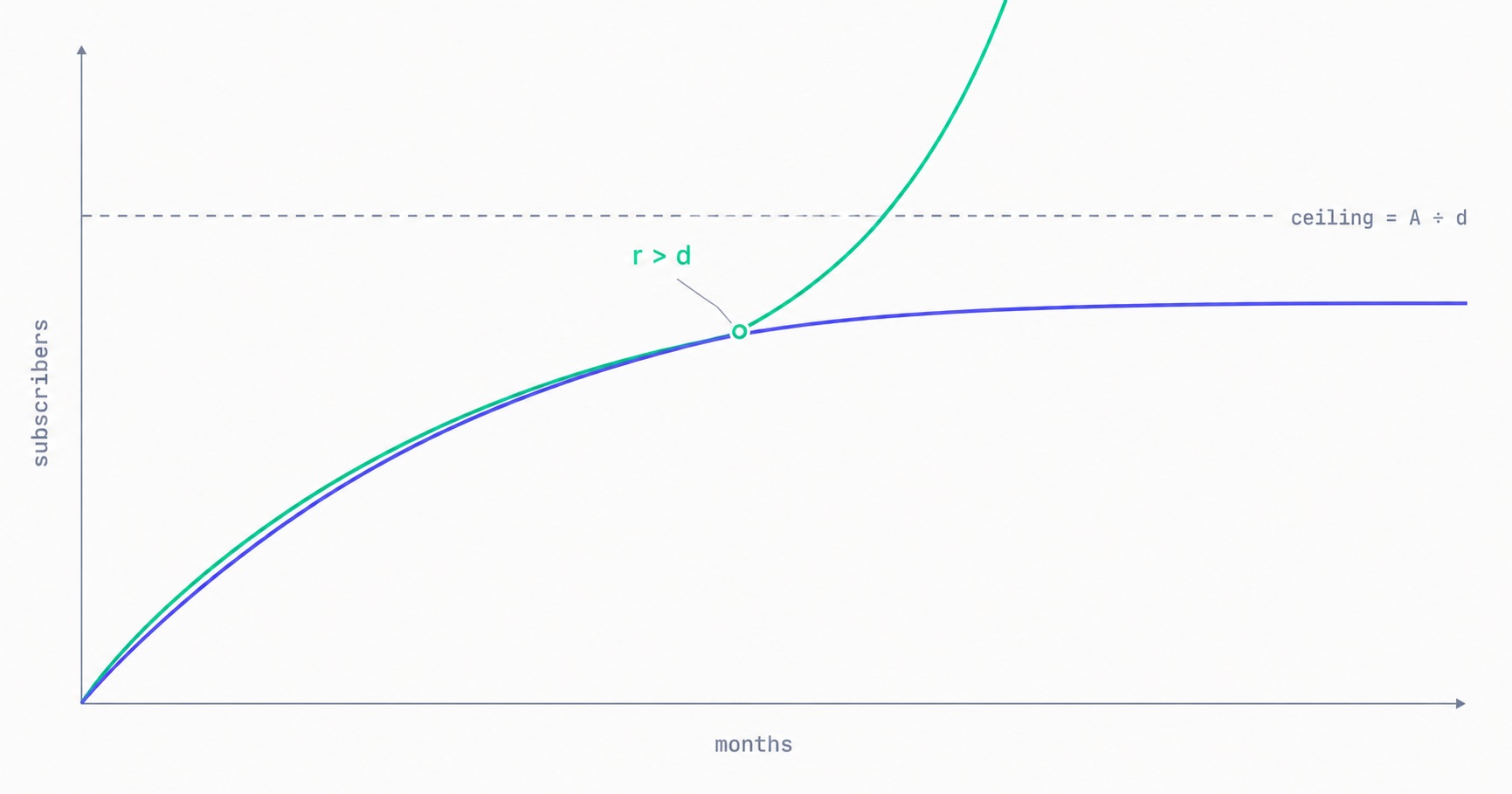
Your list has a maximum size you can calculate today: monthly new subscribers divided by monthly churn rate. At 500 signups a month and 2% churn, you will approach 25,000 and stop — no matter how long you keep publishing. The math behind the plateau, why halving churn beats doubling acquisition, and the one term that removes the ceiling entirely.

Newsletter Viral Loops: How to Make Your Subscribers Your Growth Engine
Most newsletter growth requires proportional effort. A viral loop changes this: each new subscriber creates a mechanism that brings in additional subscribers. The viral coefficient math, four loop architectures (referral, forward, access gate, social proof), stacking strategy, re-promotion system, and the content quality foundation that makes viral growth compound rather than spike.

Newsletter Cross-Promotion: How to Add 300-700 Subscribers Per Month at Zero Cost
A well-executed newsletter swap can generate 200–500 new subscribers in 48 hours at zero acquisition cost. The complete system: the 4-factor partner qualification criteria, five cross-promotion formats ranked by conversion rate, outreach pitch templates that get replies, and a monthly programme that produces subscriber growth reliably.

Newsletter SEO: How to Get Organic Traffic to Your Email Sign-Up Page in 2026
Referral programs and cross-promotions require an existing audience. SEO compounds forever and brings in subscribers who are actively searching for what you publish. The complete playbook: sign-up page optimization, blog content that converts readers to subscribers, technical SEO for newsletter sites, and backlink strategies that don't require a PR budget.

Your Readers Can Leave Without Ever Seeing Your Page.
Since 2024, Gmail and Yahoo require one-click unsubscribe. A mail-app button removes the reader instantly, with no page, no options and no reason. Your preference centre now reaches only footer-link leavers, so the 'less, not none' options belong inside the email.

They Unsubscribed, Then Signed Up Again. Now What?
Only the reader can reverse an unsubscribe. A fresh signup is a request, not proof. Why imports, forms and bulk edits quietly resubscribe people, and how to build a confirmation step that a link scanner or a stranger cannot trigger.

Moving Your Newsletter? The List Is the Easy Part.
The CSV moves in five minutes. Sender reputation, unsubscribes, paid subscriptions, automations and old signup forms do not. The order that gets a newsletter to a new platform without losing inbox placement or emailing people who opted out.
Your Free-to-Paid Rate Is Two Numbers Pretending to Be One
Long-tenured subscribers convert three to five times better than new ones, and later cohorts are acquired more broadly than early ones. Both effects correlate with join date, so they cancel inside your blended conversion rate — and the two situations they describe call for completely opposite responses. The same-tenure comparison that separates them.