Two Newsletters Earn $10k a Month. One Is Worth $100k More.
Same monthly income, very different sale price. Published multiples put paid subscription revenue around 24-42x MRR and sponsorship-supported newsletters closer to 20-32x, which means shifting your revenue mix beats a hard 30% growth year. The four discounts buyers apply, and why they are all decided 12-18 months before anyone makes an offer.

Two newsletters both make $10,000 a month. One sells sponsorships, the other sells paid subscriptions. On published market multiples the second is worth roughly $100,000 more than the first.
Same monthly income. Same effort, roughly. A difference in sale price larger than most creators earn in a year, decided entirely by which column the money arrives in.
That is the useful thing about looking at valuation early, even with no intention of selling. The multiple is set by structural properties of the business, and almost all of them are decided twelve to eighteen months before anyone makes an offer. By the time you are in a conversation with a buyer, the number is already what it is.
The ranges, and what they are measuring
Newsletter valuations broadly follow the framework used for content businesses, and published figures cluster in a few places.
The general benchmark sits around 30 to 45 times monthly net profit, which works out to roughly 2.5 to 3.75 times annual profit. Underneath that headline, the composition matters more than the average suggests.
- Paid subscription revenue is reported around 24x to 42x monthly recurring revenue, with the stronger end of that range typically reserved for businesses with demonstrated retention.
- Free newsletters monetised through sponsorship, affiliate, and products land lower, commonly quoted at 20x to 32x monthly revenue.
- By audience type, consumer newsletters are reported in the region of 2.5x to 4.0x seller's discretionary earnings, while business newsletters in finance, technology, and healthcare reach 4.0x to 6.5x and above.
- Sustained growth adds a premium. Newsletters showing consistent month-on-month growth of around 20% are reported to attract an additional 0.5x to 1.0x, because buyers price in the trajectory rather than the snapshot.
Two clarifications before using any of these.
Profit, not revenue, most of the time. A newsletter grossing $15,000 a month while spending $9,000 on paid acquisition is a $6,000 business for valuation purposes. Creators habitually quote the top line and are surprised by the offer.
These are asking-price ranges from marketplaces and brokers. They describe what listings look like, which is not the same as what transactions close at. Treat them as a starting frame, not a quote.
Why the revenue mix moves the number so much
Back to the two newsletters at the top, with the arithmetic written out.
Ad-supported at $10,000 monthly revenue, valued at 25x: $250,000.
Subscription at $10,000 monthly recurring revenue, valued at 35x: $350,000.
A 40% difference for identical income. The reason is not that buyers prefer subscriptions aesthetically. It is that the two revenue streams have different forward risk, and a multiple is a statement about the future rather than the present.
Sponsorship revenue has to be re-sold every month. It depends on relationships that may be with you personally, on a sales process that may not survive your departure, and on an advertising market that contracts in a downturn. A buyer acquiring it is buying a pipeline they have to keep filling.
Subscription revenue renews unless something breaks. Churn is measurable, forecastable, and typically slow. A buyer acquiring it is buying a base that keeps paying while they work out what to do next.
Now compare two strategies for the year ahead.
Grow ad revenue 30%, from $10,000 to $13,000 monthly. That is a hard year of selling. At 25x it adds $75,000 of enterprise value.
Convert the same revenue to subscriptions, with no growth at all. At 35x it adds $100,000.
Changing where the money comes from beats a difficult growth year. That is a genuinely counterintuitive result and it is the single most actionable thing in this piece. The mechanics of the conversion are covered in launching a paid newsletter, and which subscribers actually convert is the subject of free-to-paid cohort analysis.
None of which means abandoning sponsorship. A mixed business is worth more than either pure form, because diversification itself reduces forward risk. The point is that the ratio is a lever, and most creators do not know it is one.
The four discounts
Multiples get quoted as ranges because buyers apply adjustments. Four of them account for most of the variance, and all four are fixable with enough notice.
1. Revenue concentration
One sponsor providing 40% of your revenue is the fastest way to compress a multiple. The buyer is not acquiring a newsletter, they are acquiring one commercial relationship with a newsletter attached, and that relationship was probably built on your personal rapport.
The threshold buyers tend to react to is any single source above roughly 20% to 25%. Below that, concentration reads as normal. Above it, the diligence questions change tone.
Fixing this takes two to three quarters of deliberately selling to new advertisers rather than renewing the easy one. If you have never sold to a cold advertiser, the first sponsor guide is the starting point, and rate card construction covers pricing the second and third.
2. Platform dependency
If your audience relationship lives inside a platform you do not control, part of what a buyer would be acquiring is a permission that can be revoked.
This is why an owned email list values differently from an equivalent following on a social platform, and why a newsletter whose subscriber acquisition depends entirely on one algorithmic channel carries a discount even when the revenue looks identical. We covered the version where this goes wrong in the account removal playbook.
Portability is the specific property buyers test: can the list be exported, can it be migrated to another sending platform, does anything break if it moves. A newsletter that cannot leave its current platform is worth less than one that can, regardless of performance.
3. Owner dependency
The largest discount and the one creators most resist hearing.
If the newsletter is your name, your voice, and your face, then what a buyer acquires is a list of people who subscribed to you. The moment you leave, the thing they bought starts degrading, and they know it.
This shows up as a lower multiple, as a demand that you stay on through an earnout, or as no offer at all. It is not a judgement on quality. A personality-led newsletter can be excellent and still be difficult to transfer.
Reducing it means separating the publication from the person over time: a masthead rather than a byline, a second writer, a format that survives a change of author, systems documented rather than held in your head. Every step in that direction is uncomfortable and every one of them raises the multiple. It also has a nearer-term payoff: a newsletter that can run without you for two weeks is a newsletter you can take a holiday from, which most solo creators have quietly given up on. The systems side of that is what planning 52 weeks ahead is really for.
4. Engagement quality
List size is the number creators quote and the one buyers care least about.
A buyer is looking at open rates, click behaviour, churn, and how engagement is distributed across subscriber tenure. A large list with declining engagement is a liability with a hosting bill, and the trajectory matters more than the level. Deliverability sits underneath all of it, since a list that increasingly lands in spam produces exactly the engagement curve buyers read as audience decay, and the fix is described in the deliverability guide.
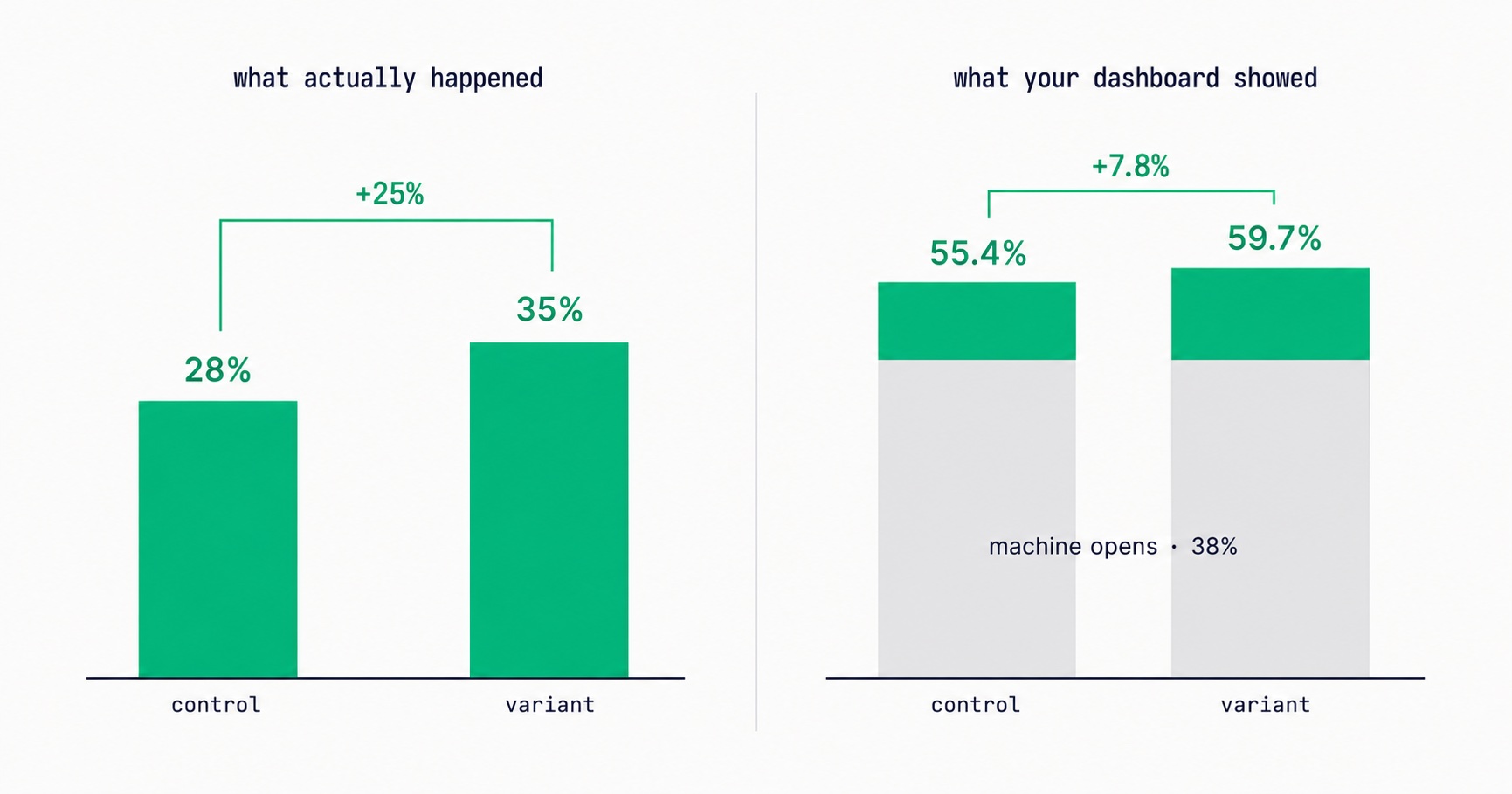
Machine-read opens complicate this, which is why click-to-delivered has become the more defensible number, as we argue in the piece on Apple MPP breaking open rates. Come to a diligence conversation with a metric that survives scrutiny rather than one that flatters. The full measurement set is in the analytics guide.
Where newsletters actually change hands
The route matters, because the same business fetches different numbers depending on who is buying and why.
Online business marketplaces. The most visible route and the one the published multiples mostly describe. Broad buyer pool, standardised diligence, and a listing fee or commission. Buyers here are usually financial rather than strategic, meaning they are pricing cash flow and will not pay a premium for anything that is not in the numbers.
Brokers. Higher touch, higher commission, and generally a better fit above a certain size because they can run a competitive process. A broker earns their fee mainly by producing more than one interested party, which is what actually moves price. A single motivated buyer sets your price at whatever they think it is worth. Two buyers set it at whatever the second one will pay, and the gap between those two situations is usually larger than any commission.
Strategic buyers. Another newsletter, a media company, or a business selling into your audience. These pay the highest multiples and they pay them for reasons that are not on your profit and loss: your subscriber list overlaps their target market, or your newsletter removes a competitor, or it gives them a distribution channel they would otherwise have to build. A strategic buyer can rationally pay more than a financial buyer for identical financials.
Direct approach from a reader. More common than expected in niche newsletters, where someone in the industry sees a business rather than a publication. These are usually the friendliest processes and frequently the least well documented, which is where clean books earn their keep.
If you have any sense the newsletter might sell one day, the strategic buyer list is worth writing down now. It is normally short, and the people on it are the ones already reading you. The cross-promotion relationships described in newsletter cross-promotion are frequently the same names.
The deal structure is half the price
A headline valuation is not an amount of money. It is a starting point for a structure, and structures vary enormously in how much of that number you actually receive.
All cash at closing is the cleanest and usually carries the lowest headline figure, because the buyer is absorbing all the forward risk. It is also the only version where the number in the agreement is the number you get.
Earnout, where part of the price depends on performance after the sale, is the standard buyer response to owner dependency. A high headline with sixty percent contingent on the newsletter hitting revenue targets while you no longer control it is a materially worse deal than a lower all-cash figure, and it is presented as a better one.
Seller financing, where you are paid in instalments from the business you sold, means you carry the risk of a buyer who runs it badly.
Transition periods are near-universal for personality-led newsletters. Three to six months of continued writing or introductions is normal. Twelve months is a job, and it should be priced as one rather than absorbed as a courtesy.
The practical guidance is to compare offers on cash at closing rather than on headline value. Two offers with the same top-line number can differ by half in what actually reaches you, and the difference correlates almost exactly with how dependent the business is on you personally.
What diligence actually looks like
Worth knowing in advance, because the gap between what creators have and what buyers ask for is where deals stall.
Revenue documentation, by source, monthly, going back two years. Not a spreadsheet you build during the sale. Bank records and platform payouts that reconcile with each other. Reconstructing this after the fact is possible and it looks exactly like reconstructing it after the fact. Published creator revenue breakdowns in our income report case studies give a sense of what a well-documented picture looks like across different business shapes.
Subscriber history with acquisition sources. How many arrived each month, from where, and how each source has performed since. A buyer is trying to work out whether growth is repeatable, and unattributed growth reads as luck. Channels that are documented and repeatable, of the kind described in referral programmes and organic search acquisition, are worth more than an equivalent number of subscribers from a source nobody can explain.
Engagement by cohort. Whether recent subscribers behave like older ones. Declining cohort quality is the clearest early signal that acquisition is degrading, and buyers look for it specifically.
Contracts and commitments. Anything a buyer would inherit: sponsor agreements, exclusivity terms, tooling contracts. Verbal arrangements with advertisers are a problem here, which is one of several reasons to put sponsorship terms in writing.
Operational documentation. What actually happens between issues, in enough detail that someone else could do it. This directly addresses owner dependency, and a documented process is worth real money because it converts an unknown into a task list. Our content calendar template is a reasonable skeleton to build it on.
The twelve-month version
If you think you might sell within a year or two, in rough order of return.
Shift revenue mix toward recurring. The largest single lever, for the arithmetic above. Even a partial shift moves the blended multiple. Products and courses count here too, since they diversify away from advertising even when they are not strictly recurring, as covered in selling digital products to a list.
Break up concentration. Get your largest revenue source under a quarter of the total. This is slow, which is exactly why it has to start early.
Clean up the books. Separate business banking, categorised expenses, revenue reconciling to bank records. Unglamorous and it prevents more deals from dying than anything else on this list.
Document the operation. Every process out of your head and into a written form. It reduces owner dependency and it is the only item here that also makes your current life easier.
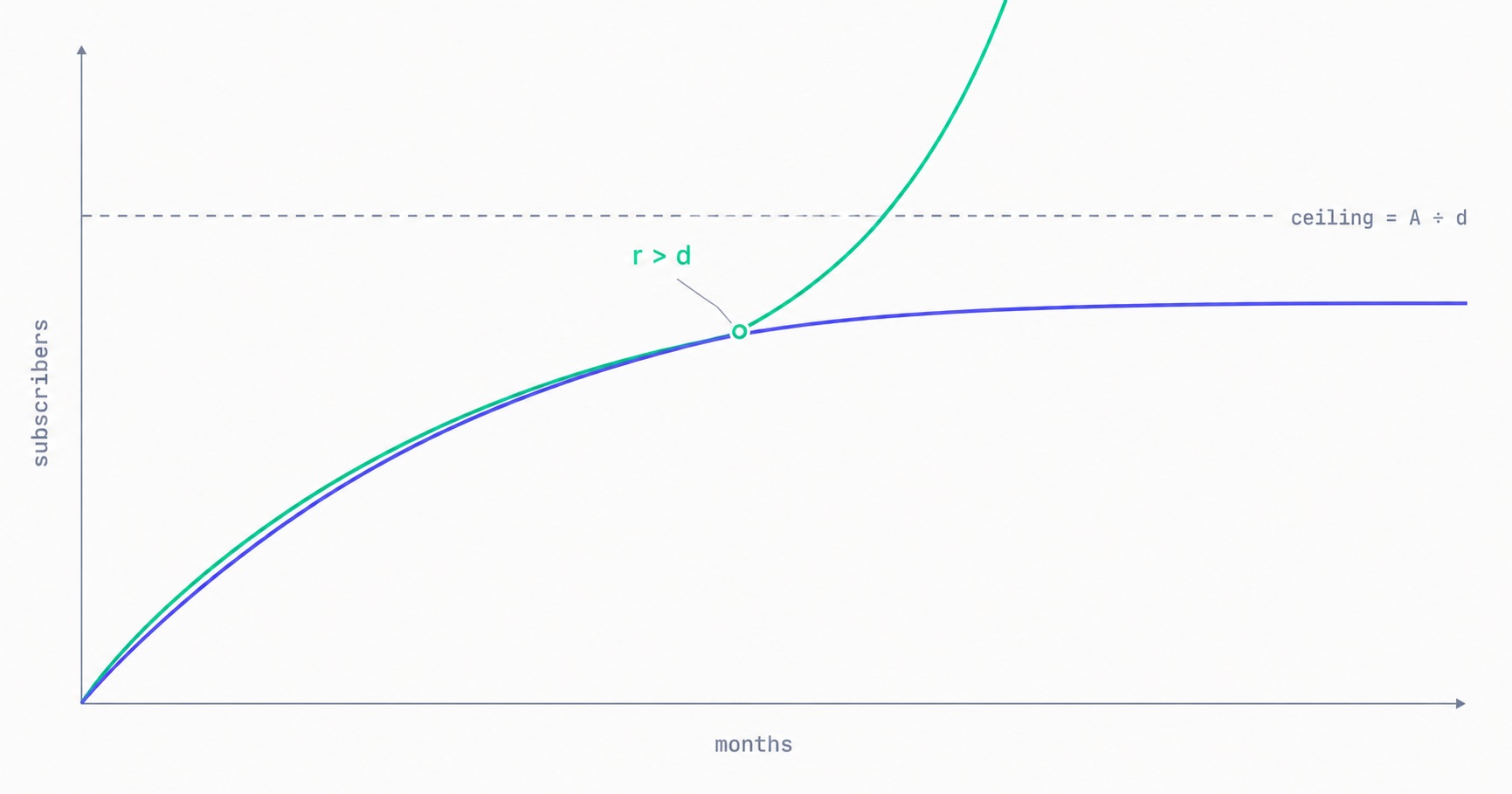
Fix churn before chasing growth. Retention affects the multiple through two channels at once, since it improves both the engagement picture and the forward revenue forecast. The compounding argument is in the growth ceiling piece and the tactics are in reactivation campaigns.
Reduce platform risk. Confirm you can export everything and that migration is genuinely possible. Test it rather than assuming. Platform differences on export and migration are compared in the platform comparison, and they vary more than most creators expect until the day they need it.
The reason to do this without selling
Every item on that list is something a well-run newsletter should have anyway.
Diversified revenue is more stable. Documented processes make you replaceable in the good sense, which is what allows a holiday. Clean books make tax season shorter. Portability protects you against a platform decision you did not get a vote on. Low churn is the difference between a business that compounds and one that runs to stand still, as the ceiling arithmetic shows.
The valuation frame is useful mainly because it forces a specific question that day-to-day operation never asks: if I disappeared tomorrow, what would still work?
Whatever survives that question is the business. Whatever does not is a job you have built for yourself, and the difference between the two is most of the gap between a 2.5x multiple and a 6x one. Worth noting that this is not an argument against personality-led newsletters, which are frequently the best ones to read and the most enjoyable to write. It is an argument for knowing which kind you are running, because the two have different exit paths and only one of them ends in a clean sale. A creator whose newsletter is inseparable from them is building an income rather than an asset, and that is a legitimate choice as long as it is a choice.
If you want to see what the underlying numbers look like on your own list, the revenue calculator is a starting point, and the monetisation tools cover running subscription and sponsorship revenue side by side rather than choosing between them.
Frequently asked questions
How much is my newsletter worth?
Published ranges cluster around 30 to 45 times monthly net profit, or roughly 2.5 to 3.75 times annual profit, with wide variation by revenue type. Paid subscription revenue is quoted around 24x to 42x monthly recurring revenue while sponsorship-supported newsletters sit closer to 20x to 32x. Business newsletters in finance, technology, and healthcare reach the higher end. Note these are marketplace asking ranges rather than closed transaction data, and note the base is profit rather than revenue.
Why are paid newsletters worth more than ad-supported ones?
Because a multiple prices forward risk. Subscription revenue renews by default and churn is forecastable, so a buyer inherits a base that keeps paying. Sponsorship revenue has to be re-sold every month through relationships that may be personal to the seller, in an advertising market that contracts in downturns. The same $10,000 a month can be worth around $250,000 as ad revenue and around $350,000 as recurring subscription revenue.
Does subscriber count determine my valuation?
Much less than creators expect. Buyers price revenue, profit, and forward risk. List size matters only through its effect on those, so a large list with poor engagement and no monetisation values below a smaller, well-monetised, highly engaged one. Engagement trajectory by subscriber cohort tends to receive more scrutiny in diligence than the headline total does.
What lowers a newsletter's valuation the most?
Four things, roughly in order. Owner dependency, where the audience subscribed to a person rather than a publication. Revenue concentration, where one sponsor or partner exceeds about a quarter of income. Platform dependency, where the audience relationship or the acquisition channel sits inside something you do not control. And declining engagement, particularly when recent subscriber cohorts underperform older ones.
How long before selling should I start preparing?
Twelve to eighteen months for the changes that matter. Shifting revenue mix, breaking up concentration, and reducing owner dependency all take multiple quarters to show up in the trailing data a buyer will examine. Bookkeeping can be tidied faster but not retroactively created. A newsletter prepared during the sale process looks exactly like one prepared during the sale process.
Do I need clean financials to sell a newsletter?
Yes, and the absence of them kills more deals than valuation disagreements do. Buyers want revenue by source, monthly, for two years, reconciling to bank records and platform payouts. Personal and business expenses mixed in one account is the most common problem and the most easily prevented. Separate the banking now even if a sale is hypothetical.
Should I think about valuation if I never plan to sell?
It is a useful lens regardless, because everything that raises a multiple also makes the business better to run. Diversified revenue is more stable, documented processes let you take a break, clean books shorten tax season, and portability protects you from a platform decision you had no vote in. The valuation frame is mainly a way of asking which parts of your operation would survive without you.
Stay Updated
Get the latest insights, strategies, and tips delivered directly to your inbox. Join thousands of creators who are building their email communities with our weekly newsletter.
No spam, unsubscribe at any time. We respect your privacy.
Related Articles

You Cannot Pause a Newsletter. Only Stop Sending One.
Churn continues, acquisition stops, and sender reputation degrades fast while recovering over four to twelve weeks. Which makes an eight-week break cost far more than eight weeks — and makes reducing frequency a completely different decision from stopping.

You Cannot Unsend a Newsletter. Write the Contract First.
A video can be unlisted, a post deleted. A send is gone, which means every piece of leverage you had disappears the moment you deliver. What actually needs to be in writing: the five-part payment clause, why you take a deposit, and the performance guarantee that makes you liable for someone else's landing page.

Your Free-to-Paid Rate Is Two Numbers Pretending to Be One
Long-tenured subscribers convert three to five times better than new ones, and later cohorts are acquired more broadly than early ones. Both effects correlate with join date, so they cancel inside your blended conversion rate — and the two situations they describe call for completely opposite responses. The same-tenure comparison that separates them.

Your Account Was Removed. Here's the First 24 Hours.
Account recovery is a sequence ordered by decay, not a checklist. Some assets are recoverable in the first hours and gone within days; others can wait. What to export before access closes, why filing a second appeal usually sets you back, who to contact before they find out elsewhere, and how to rebuild in parallel rather than after.

How to Create a Paid Membership Newsletter: Tiers, Pricing, and Content Strategy
Paid newsletters generate revenue that compounds with every subscriber and is immune to algorithm changes. The complete framework: pricing that reflects actual content value, the free-to-paid content split that converts without giving everything away, founding member launch mechanics, retention systems that reduce churn, and the platform fee math that decides how much you actually keep.

How to Launch a Paid Newsletter: Complete Step-by-Step Guide for 2026
The paid newsletter market is $2B+ and growing. But most creators launch wrong — wrong pricing, wrong timing, wrong content split. This is the definitive playbook: when you're actually ready, how to price it, the 14-day pre-launch sequence, and why 0% platform fees matter enormously at scale.

Your Readers Can Leave Without Ever Seeing Your Page.
Since 2024, Gmail and Yahoo require one-click unsubscribe. A mail-app button removes the reader instantly, with no page, no options and no reason. Your preference centre now reaches only footer-link leavers, so the 'less, not none' options belong inside the email.

They Unsubscribed, Then Signed Up Again. Now What?
Only the reader can reverse an unsubscribe. A fresh signup is a request, not proof. Why imports, forms and bulk edits quietly resubscribe people, and how to build a confirmation step that a link scanner or a stranger cannot trigger.

Moving Your Newsletter? The List Is the Easy Part.
The CSV moves in five minutes. Sender reputation, unsubscribes, paid subscriptions, automations and old signup forms do not. The order that gets a newsletter to a new platform without losing inbox placement or emailing people who opted out.

A Subscriber Is Worth $1.25 a Year. Now Price Your Ads.
Two sponsored slots at a $30 CPM with a 40% open rate earn about $1.25 per subscriber per year. Against a defensible CAC near $2 and cost-per-signup commonly $2-5, most paid acquisition is at or past break-even before you account for paid cohorts converting worse than organic ones.
Apple Broke Your Open Rate. And Your Subject Line Tests.
Every article about Apple Mail Privacy Protection says open rates are unreliable. None of them explain the part that actually changes your decisions: MPP doesn't add random noise, it systematically compresses the measured gap between two subject lines by roughly 3x — which is why so many creators ran good tests, saw flat results, and concluded subject lines don't matter.
Your Newsletter Has a Growth Ceiling. Here's the Formula.
Your list has a maximum size you can calculate today: monthly new subscribers divided by monthly churn rate. At 500 signups a month and 2% churn, you will approach 25,000 and stop — no matter how long you keep publishing. The math behind the plateau, why halving churn beats doubling acquisition, and the one term that removes the ceiling entirely.