Newsletter Strategy for Course Creators: Build Your List, Warm Your Audience, Fill Your Program
Course sales require the deepest trust of any creator product. Email is the only channel that builds that trust systematically. The complete system: lead magnets that pre-qualify students, a 10-email welcome sequence designed for enrollment, inter-launch content strategy, launch sequence framework, post-launch re-engagement, and evergreen enrollment system.

Course creators have a sales problem that most marketing advice misses: the product they sell requires the most trust-intensive purchase decision in the creator economy. A $497 online course is not an impulse buy. The person who pays it has already decided they want to learn this topic, evaluated multiple options, decided you specifically are worth learning from, and decided the outcome justifies the investment. That sequence of decisions takes weeks or months, not minutes.
This is exactly what email is built for. Email is the only marketing channel that compounds trust through repeated, consistent, substantive contact over a sustained period. Social media posts are seen once and forgotten. Paid ads interrupt rather than build relationships. A newsletter, sent consistently with high editorial quality, creates a subscriber who has read 20 of your pieces, engaged with your thinking, and arrived at their enrollment decision fully informed and convinced — without a single sales call.
The course creators generating $10,000–$100,000+ per launch from their email lists are not doing something fundamentally different from those generating $1,000. They have built a more sophisticated version of the same system: a qualified lead magnet that attracts the right profile of potential student, a welcome sequence that begins course-specific trust-building immediately, an ongoing newsletter that sustains that trust between launches, and a launch sequence that converts warm subscribers at rates cold traffic never approaches. This guide builds that system end to end.
Why Email Outperforms Every Other Channel for Course Sales
The data on email versus social media for course sales is not ambiguous. Email consistently generates conversion rates of 1–5% per launch to a warm list. The same launch promoted to social media followers at equivalent numbers generates 0.1–0.5%. The 5–10x differential is structural — it reflects the difference between an audience that chose to hear from you versus one that happens to follow you and may or may not see any given post.
Paid advertising can drive course sales but cannot replicate the trust dimension of email. A Facebook ad reaches someone who demographically matches your ideal student — but that person has never read your writing, never engaged with your thinking, and has no prior relationship with you. Their conversion decision is cold. An email subscriber who has been reading your newsletter for three months has a relationship built through repeated value delivery. Their conversion decision is warm — often the only remaining question is timing, not whether.
Email compounds in a way social media cannot. A subscriber who joins today may not be ready to buy your course for six months — but if your newsletter consistently delivers value during those months, they will be ready when the moment arrives. The email subscriber gets every issue you send, building a relationship that deepens with each one. This compound trust dynamic is why experienced course creators almost universally prioritise email list growth above every other marketing activity. The revenue data from newsletter creators at different subscriber tiers consistently shows that email-driven course launches outperform social and paid channels by orders of magnitude at equivalent audience sizes.
The Lead Magnet: Attracting the Right Students, Not Just Any Subscribers
For course creators, the lead magnet serves a dual purpose that no other creator category faces as acutely: it must attract email signups AND pre-qualify those signups as potential students for a specific course. A generic lead magnet that maximises subscription volume is wrong for course creators because unqualified subscribers inflate your list while contributing nothing to enrollment rates — making your metrics look healthy while your launch revenue underperforms.
The lead magnet that serves course creators best addresses the same core problem your course solves, at one level of depth shallower than the course itself. If your course teaches freelance copywriters to charge premium rates, your lead magnet should address the surface-level expression of that problem: why most copywriters undercharge and what to do about it. Anyone who downloads this has self-selected as someone experiencing the exact problem your course addresses — the most valuable filter available in your entire marketing funnel.
Lead magnet formats that pre-qualify course buyers:
- The diagnostic or self-assessment: A structured evaluation helping subscribers understand where they sit relative to the outcome your course delivers. People who complete a diagnostic are actively evaluating their situation — the mental posture immediately preceding a purchase decision. The results also give you segmentation data: a subscriber who scored 2/10 on your assessment is a hotter prospect than one who scored 8/10 and may not need the course at all.
- The partial framework: One module or framework from your course, presented as a standalone resource. This delivers genuine value, demonstrates your course content quality, and creates a natural curiosity gap. Subscribers who find the framework valuable immediately wonder what the rest of the course contains — structurally more compelling than a generic sample lesson because it feels like access to your actual methodology.
- The results-showcase case study: A detailed narrative of a student achieving the outcome your course targets, with enough specificity that readers can map their own situation onto the story. Subscribers who read it and think "this is exactly where I am" have pre-qualified themselves as prospects. Particularly effective for transformation-oriented courses where seeing a real example of the transformation creates belief that the outcome is achievable.
- The mini email course (5 days): A structured sequence teaching a foundational element of your topic, one email per day. Completion rate data — which subscribers finish all five emails — is your highest-signal proxy for course purchase intent. Someone who voluntarily reads five emails about your topic over five days has demonstrated exactly the learning orientation that successful course students need.
The Welcome Sequence: 14 Days That Do the Heavy Lifting
New subscribers open their first email at 50–80% rates — the highest engagement window in any subscriber's lifecycle with your newsletter. For course creators, this window is the most commercially important period in the subscriber relationship. Most creators waste it with a single "thanks for subscribing, here's your download" email that communicates nothing about who you are, what transformation you produce, or what the course experience looks like.
A purpose-built welcome sequence for course creators runs 7–10 emails over 10–14 days, with every email designed for a specific job in the pre-enrollment journey: establishing your authority, demonstrating your methodology, building belief that the outcome is achievable, handling common objections before the subscriber consciously raises them, and eventually introducing the course itself — all before a single formal launch email is sent.
Course creator welcome sequence — email-by-email framework (10 emails, 14 days):
- Email 1 (immediate): Lead magnet delivery + brief origin story. Why you teach this topic. Under 200 words — the subscriber came for the resource first.
- Email 2 (Day 2): The problem diagnosed at depth. Not the surface symptom but the root cause most people never identify. Showing you understand the problem more deeply than generic advice is the most powerful authority signal available.
- Email 3 (Day 4): Your named methodology or framework — the specific approach that makes your course different. Named frameworks are more memorable and credible than generic process descriptions.
- Email 4 (Day 6): A student result story told as narrative. Who they were, where they started, what changed. Specific enough to be credible. Relatable enough to create identification. One direct quote from the student.
- Email 5 (Day 8): Your best free teaching — a genuinely valuable piece demonstrating what your course instruction quality looks like. High-quality free instruction increases purchase intent because it previews the paid experience at its best.
- Email 6 (Day 9): A second student result story covering a different starting situation to broaden identification.
- Email 7 (Day 10): Objection handling. Address the three most common reasons people do not enroll: time, cost, readiness. Answer each honestly — not dismissively.
- Email 8 (Day 12): The course introduction — what it is, who it's for, curriculum overview. Written as information-sharing, not selling. A subscriber who received seven emails of genuine value will receive this as a natural next step.
- Email 9 (Day 13): FAQ email covering the practical questions students ask before enrolling: time commitment, support options, refund policy, access duration.
- Email 10 (Day 14): Course CTA with a genuine reason to act now. One clear action, one clear link.
This sequence runs automatically through your email automation setup for every new subscriber. Every person who discovers you — through a podcast, a social post, an organic search result — goes through the same carefully crafted introduction to your methodology, your proof, and your course. Set it up once and it works indefinitely.
The Ongoing Newsletter: Sustaining Trust Between Launches
Your welcome sequence handles the first two weeks. Between launches — often 50 or more weeks of the year — the ongoing newsletter maintains the relationship and keeps the course in the subscriber's awareness without becoming a continuous sales pitch.
The editorial mistake most course creators make is letting their newsletter become a launch preparation tool — sending interesting content only when a launch is approaching, then going quiet. Subscribers learn this pattern quickly. When you go quiet, they know a pitch is coming. When it arrives, it feels transactional rather than relational. The newsletters that produce the highest launch conversion rates deliver consistent value year-round regardless of whether a launch is imminent. Trust accumulated through 40 consistent, non-promotional newsletters is what makes the 41st newsletter — the launch announcement — convert at rates that seem implausibly high to creators who have not built that foundation.
Inter-launch content types that build course purchase intent:
- Student spotlight issues: Deep profiles of course graduates 6–12 months after completion. These answer the ultimate question prospective students have: does this actually work, and does the result last? A well-written student spotlight regularly prompts enrollment inquiries from subscribers who have been on the fence for months.
- The lesson application issue: Take a specific concept from your course and apply it to a current, timely situation in your niche. Keeps your methodology front-of-mind without explicitly promoting the course. Demonstrates ongoing, practical relevance rather than static curriculum.
- Behind-the-scenes teaching: What do most people in your niche get wrong? What does the research show versus the conventional wisdom? Original, substantive takes build the deepest authority over time. A subscriber who has seen you be right about 15 counterintuitive things over eight months will enroll partly as an act of continued trust in your judgment.
- The Q&A issue: Answer subscriber questions directly. This surfaces the objections most commonly standing between subscribers and enrollment, and demonstrates the accessibility that buyers of a high-touch product like a course need to see before committing.
Publishing weekly is the right frequency for most course creator newsletters. The content calendar system that batch-produces four issues in one focused session is particularly valuable for course creators, whose creative energy is often consumed by curriculum development and student support. Having a four-week content buffer removes weekly production pressure without reducing consistency.
Segmentation: Managing Prospects at Different Stages of the Journey
As your list grows, you will have subscribers at dramatically different stages of the buyer journey: someone who subscribed yesterday and has read one email, someone who has been reading your newsletter for 14 months and consumed every piece of content you have published, and everyone in between. Treating all of these subscribers identically — sending the same content, the same promotional cadence, the same course introduction — wastes the nuance of these different relationships and produces lower conversion rates than segmented communication achieves.
The segmentation that matters most for course creators is engagement-based: separating highly engaged subscribers (opens every email, clicks frequently) from moderately engaged (opens most, occasional clicks) from inactive (no opens in 60+ days). These three cohorts should receive different versions of your launch sequence. Highly engaged subscribers need primarily urgency and logistics to make a decision. Moderately engaged subscribers benefit from a fuller sequence with more proof and objection handling. Inactive subscribers should receive a re-engagement campaign before any launch sequence — a promotional email to a disengaged subscriber contributes to spam complaints and damages your deliverability for the rest of your list.
The Launch Sequence: Converting Warm Subscribers to Enrolled Students
A course launch is a defined enrollment window — typically 7–14 days — during which your newsletter pivots to enrollment mode. This is appropriate and expected; subscribers who have been reading your content know you offer a course, and a periodic enrollment window is a natural part of a creator's business relationship with their audience. The key is that the launch sequence feels like a continuation of the relationship, not a sudden commercial interruption of it.
Course launch sequence structure (10 days, 7 core emails):
- Day 1 — Cart open: Announce the enrollment window. Reference the course by name, name the dates, lead with your most compelling transformation story.
- Day 2 — Curriculum deep-dive: Walk through what the course covers as a narrative journey, not a bullet list. What the student will be able to do after each section.
- Day 4 — Social proof email: Multiple student testimonials with specific, quantified outcomes. Lead with numbers wherever possible.
- Day 6 — Objection email: Address hesitations about time, cost, and whether it will work for their specific situation. Honest and empathetic responses — not dismissals.
- Day 8 — Urgency update: Honestly report enrollment status. Spots remaining, cohort start date, any expiring bonus. Genuine urgency produces action; manufactured urgency produces unsubscribes.
- Day 9 — FAQ email: Practical last-chance answers. Refund policy, time commitment, support structure, access duration.
- Day 10 — Cart close: Final reminder sent twice, morning and evening. No new information — just the deadline and the link.
Building Your List: Channels That Attract Course-Ready Prospects
Course creators benefit from long-form content channels more than most creator categories because the same expertise justifying a premium-priced course can fuel an authority-building content engine that compounds over time. Long-form content — blog posts, YouTube videos, podcast episodes — self-selects for engaged, motivated prospects. Someone who watches a 20-minute tutorial on your course topic and then subscribes has demonstrated a level of interest that a social media follower has not. The newsletter SEO strategy that ranks long-form content in search creates a subscriber acquisition system running continuously without ongoing effort after the initial setup.
Podcast guesting is the second most productive channel for course creator list-building. A 45-minute appearance demonstrating your expertise generates subscribers who arrive with higher trust than almost any other channel. Always direct listeners to your lead magnet specifically — not your website homepage — with a short, memorable URL you state verbally during the episode. The podcast-to-email list strategy applies directly to course creators using guesting as an awareness channel.
Partnerships with complementary course creators reach audiences that have already demonstrated course-buying behaviour. Someone who has purchased a course from a complementary creator has cleared every psychological barrier to buying online courses. Newsletter swaps with adjacent course creators are among the highest-ROI subscriber acquisition activities available because subscriber quality is uniquely high. Supplement with a structured referral programme that incentivises your past students — your best advocates — to bring in new prospects from their networks.
Post-Launch: Converting Non-Buyers and Re-Engagement
Every launch produces three outcomes: buyers who enrolled, engaged non-buyers who were interested but did not pull the trigger, and passive non-buyers who read the launch emails but showed no signs of active consideration. Each group warrants a different post-launch communication approach, and most course creators treat all three identically — ceasing promotional communication and returning to regular newsletter content — which leaves engaged non-buyers unconverted despite their demonstrated interest.
Engaged non-buyers are the most commercially valuable segment after a launch closes. They opened launch emails, likely clicked through to the sales page, and for whatever reason — timing, budget constraints, lingering hesitation — did not enroll. Within 48 hours of cart close, send this group a single post-launch email that does two things: acknowledges that the enrollment window has closed, and opens an alternative pathway. This might be a waitlist for the next cohort, a payment plan option you did not prominently feature during the launch, or a lower-entry-point offer (a standalone module, a guide, a consultation) that captures value from someone who wanted to buy but could not commit to the full programme at that moment.
The post-launch re-engagement campaign also addresses the subscribers who entered a dormant state during the launch period — those who stopped opening emails because every issue was promotional. A "back to normal" email that explicitly acknowledges the launch is over and signals the return to your regular content schedule reduces churn from this group, which would otherwise drift toward inactivity and eventually unsubscribe. Maintaining the subscriber relationship after a promotional period requires actively communicating that the relationship is not transactional — a single high-quality non-promotional issue sent immediately after cart close resets the editorial baseline and signals that your newsletter is worth staying subscribed to outside launch windows.
Long-term, each launch cycle should be documented as a learning asset. Which launch emails had the highest open and click rates? Which objection-handling email generated the most direct replies? Which proof format — case study, testimonial, specific outcome data — drove the most cart-open-to-purchase conversions in the launch analytics? This documentation improves every subsequent launch and reduces the marginal effort required to produce a high-performing sequence over time. A creator on their fifth launch operating from a documented playbook typically generates 40–60% more revenue per subscriber than they did on their first launch — not because their list is different, but because their execution is more precisely calibrated to their specific audience's behaviour patterns.
Evergreen Enrollment: Revenue Between Launch Windows
Most course creators treat email as a launch-only revenue tool. This leaves significant evergreen revenue unrealised. Your course sales page exists permanently between launches. Your welcome sequence runs for every new subscriber. The conditions for course enrollment exist year-round — but only if you build a pathway that captures the subscribers who reach their personal decision point between formal launch windows.
Creators who add an evergreen pathway typically find that 20–40% of their annual course revenue arrives outside formal launch windows — income that was always available but not deliberately captured. This requires a welcome sequence with a clear course CTA at the appropriate moment, a high-converting sales page functioning as a self-service enrollment path for subscribers who arrive ready to buy, and an ongoing newsletter that periodically mentions the course in context without making every issue a promotional send.
Between launch windows, consider programmatic newsletter ads and direct sponsorships — these monetise your newsletter's audience value during the periods when course revenue is quiet, turning inter-launch newsletters from a cost centre into a revenue stream. The income profiles from creators running multi-stream revenue models consistently show that the highest earners maintain revenue across multiple channels simultaneously rather than depending on course launches as their sole income event.
Platform and Analytics Considerations for Course Creators
Course creators have specific platform requirements: strong automation for multi-email sequences, tag-based segmentation for prospect stage management, and the ability to handle both the editorial newsletter relationship and the structured sales funnel within the same system. The Kit vs. InfluencersKit comparison covers this decision in detail for creators who want newsletter-native monetization alongside course sales. The three-way platform comparison provides the full context for creators evaluating the complete platform landscape.
Measuring the system requires connecting email analytics to revenue outcomes. Open rates and click rates on individual emails tell you which content resonates; the metrics that tell you whether your course email system is actually working are subscriber-to-inquiry rate, subscriber-to-enrollment rate, and average time-to-enrollment. Track these in your email analytics dashboard alongside standard engagement metrics to understand whether your email system is genuinely driving course enrollment or simply maintaining an engaged but non-converting audience. These are the business-level metrics that distinguish a high-performing course creator email system from one that looks healthy on the surface but is not producing the enrollment pipeline it should be.
Regardless of platform, deliverability fundamentals must be correct before any launch. A launch email hitting spam folders for 30% of your list is a launch generating 30% less revenue than your list size warrants. Authenticate your sending domain, remove chronically inactive subscribers before each launch, and test inbox placement before every major campaign. The free vs. paid platform breakdown helps identify which tier provides the deliverability infrastructure your launch system requires.
The Long Game: Why Course Creator Email Lists Appreciate Over Time
Course creator email lists have a distinctive characteristic that distinguishes them from content creator email lists and product business email lists: they appreciate in value over time rather than depreciating. A subscriber who has been on your list for 18 months and has read 70+ issues of your newsletter without purchasing your course is not a cold lead — they are a deeply warmed prospect who has demonstrated extraordinary tolerance for a long consideration period. Something is preventing them from converting — typically a timing factor (budget cycle, career stage, personal circumstances) rather than a fundamental disinterest in the outcome your course delivers.
These long-tenure non-buyer subscribers convert at above-average rates in specific launch conditions: when the cohort timing aligns with a personal transition point in their life, when a price change creates urgency, or when a new curriculum element or delivery format addresses a concern they had about the original offering. Running "re-engagement launch sequences" specifically targeted at subscribers who have been on your list for 12+ months without purchasing — acknowledging their long tenure, referencing the content you have been sharing, and asking directly whether there is a specific barrier to enrollment — generates conversions from subscribers who had effectively been written off as non-buyers.
The other characteristic that makes course creator email lists appreciate over time is student outcomes. Every student who completes your course and achieves meaningful results becomes an asset for your newsletter — a testimonial, a case study, a social proof element that makes future launches more persuasive than past ones. The newsletter that is one year old has stronger launch proof than the newsletter that launched three months ago, even if the subscriber count is identical. Systematically collecting and showcasing student outcomes through your newsletter content is not just editorial content — it is launch infrastructure that compounds with every graduate.
Email Infrastructure Built for Creators Who Sell and Publish
InfluencersKit combines the automation depth course creators need — multi-sequence welcome flows, engagement-based segmentation, launch scheduling — with newsletter monetization tools that generate revenue from ads and sponsorships between launches. List-building tools, subscriber management, and monetization features in one platform. Check the full pricing before deciding.
Start your free trial — build your welcome sequence this week and start converting subscribers to students automatically.
Stay Updated
Get the latest insights, strategies, and tips delivered directly to your inbox. Join thousands of creators who are building their email communities with our weekly newsletter.
No spam, unsubscribe at any time. We respect your privacy.
Related Articles

How to Monetize Your Email List in 2026: 7 Proven Strategies for Content Creators
Turn your email list into a revenue-generating asset with these 7 proven monetization strategies. From programmatic ads to paid subscriptions, learn exactly how content creators are earning consistent income from their newsletters in 2026.

Your Readers Can Leave Without Ever Seeing Your Page.
Since 2024, Gmail and Yahoo require one-click unsubscribe. A mail-app button removes the reader instantly, with no page, no options and no reason. Your preference centre now reaches only footer-link leavers, so the 'less, not none' options belong inside the email.

They Unsubscribed, Then Signed Up Again. Now What?
Only the reader can reverse an unsubscribe. A fresh signup is a request, not proof. Why imports, forms and bulk edits quietly resubscribe people, and how to build a confirmation step that a link scanner or a stranger cannot trigger.

Your List Grew 1,500 Overnight. None of Them Are Real.
A signup spike with no launch behind it is usually list bombing. Fifteen hundred fake signups can push a welcome stream to six times Gmail's complaint limit and overstate your list by 30% to sponsors. How to spot them, why Apple Mail hides some, and how to clean up without making it worse.

Moving Your Newsletter? The List Is the Easy Part.
The CSV moves in five minutes. Sender reputation, unsubscribes, paid subscriptions, automations and old signup forms do not. The order that gets a newsletter to a new platform without losing inbox placement or emailing people who opted out.
Apple Broke Your Open Rate. And Your Subject Line Tests.
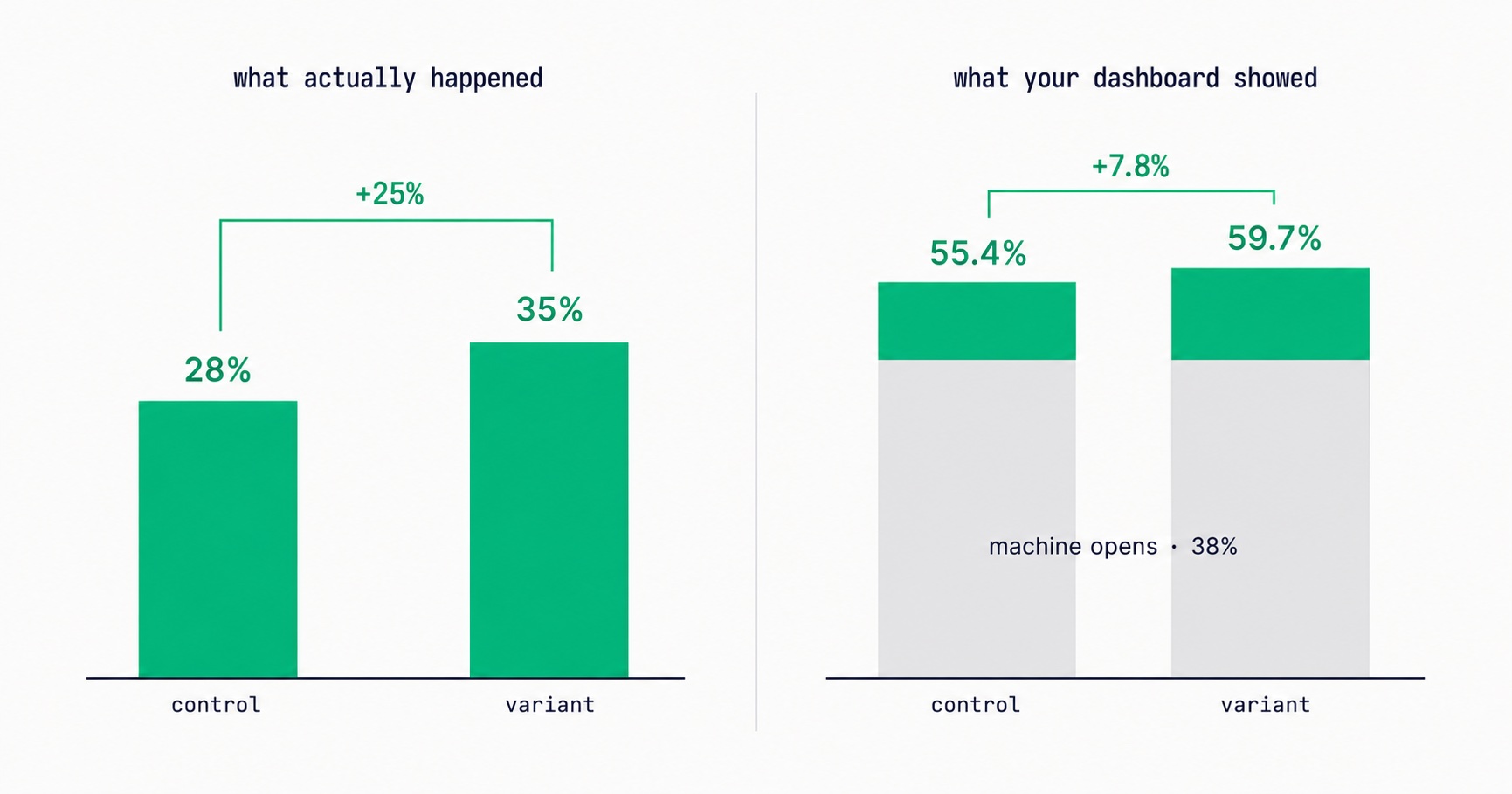
Every article about Apple Mail Privacy Protection says open rates are unreliable. None of them explain the part that actually changes your decisions: MPP doesn't add random noise, it systematically compresses the measured gap between two subject lines by roughly 3x — which is why so many creators ran good tests, saw flat results, and concluded subject lines don't matter.

Newsletter Upsell Strategies: How to Sell Digital Products to Your Email Subscribers
Email converts digital product sales at 40x the rate of social media — yet most newsletter creators undermonetize because they upsell incorrectly. The complete architecture: the 7-email post-subscribe sequence that warms subscribers before the pitch, the four mid-issue CTA formats ranked by conversion rate, dedicated launch issue structure, product-type positioning for courses/templates/ebooks/coaching, segmentation-based upselling, and the non-buyer re-engagement approach that reaches subscribers on their own timeline.

Flodesk vs InfluencersKit: Which Email Platform Is Right for Your Creator Business?
Flodesk was built for beautiful emails. InfluencersKit was built for creator revenue. That design philosophy drives every product decision — and determines which platform is right for your business model. Honest comparison across pricing (including the flat-rate illusion), automation, monetization (where the gap is decisive), analytics, growth tools, and a three-year opportunity cost calculation that most platform reviews never run.
How to Create a Paid Membership Newsletter: Tiers, Pricing, and Content Strategy
Paid newsletters generate revenue that compounds with every subscriber and is immune to algorithm changes. The complete framework: pricing that reflects actual content value, the free-to-paid content split that converts without giving everything away, founding member launch mechanics, retention systems that reduce churn, and the platform fee math that decides how much you actually keep.
Newsletter Reactivation: How to Win Back Inactive Subscribers (With Templates)
Every newsletter has inactive subscribers silently dragging down deliverability. A well-designed reactivation campaign recovers 8–20% of them while identifying the truly unrecoverable. The four-part reactivation sequence, subject lines that break through inbox habituation, the list hygiene logic that improves metrics after removal, and the onboarding system that prevents inactivity from accumulating in the first place.
Affiliate Marketing for Newsletter Creators: Building a Recurring Commission Base in 2026
The gap between $200/month and $4,000/month in affiliate income usually isn't audience size — it's programme selection (recurring vs. one-time commissions), recommendation quality, and placement architecture. The complete system: which programmes compound, how to integrate recommendations without damaging editorial trust, and the month-by-month build to a passive recurring base.
Email Marketing for Online Coaches: Build Your List, Nurture Prospects, Fill Your Program
Coaching has a long sales cycle — clients need weeks of trust-building before they commit. Email is the only marketing channel that matches this cycle structurally. The complete system: how to build a list that attracts your ideal client profile, the 7-email welcome sequence that pre-qualifies prospects, and how to run enrollment conversations through email without feeling salesy.